The Best Heat Pump Options for Cold Climates
It’s the number one question we get at Climate Plus when the leaves start falling and homeowners start dreading their winter heating bills: “Can a heat pump really keep my house warm when it’s freezing outside?”
The short answer? Yes, modern heat pumps work incredibly well in North Jersey winters. In fact, modern cold-climate heat pump systems can keep your home toasty even when outdoor temperatures plunge below zero.
If you are a homeowner in North Jersey, your skepticism is completely justified. We aren’t dealing with mild coastal winters up here in Sussex, Passaic, or Morris counties. We get real snow, deep freezes, and biting winds. You need a home heating system that actually does its job, not one that gives up when the temperature dips below freezing.
For years, the rumor was that heat pumps only worked down south. HVAC technology has changed massively over the last decade and what Climat Plus has experience out in the field since 1990.
But there are a few “insider secrets” about how they operate, how they feel, and how they handle North Jersey snowstorms that most contractors won’t tell you. Climate Plus will clear the air and look at exactly what you can expect.
How Can a Heat Pump Pull Heat from Freezing Air?
To understand how a heat pump survives a North Jersey winter, you have to know how it works.
A heat pump doesn’t create heat by burning fuel like a gas or oil furnace. Instead, it moves heat. It operates exactly like your refrigerator or air conditioner, just in reverse.
Even when it is 10°F outside, there is still thermal energy (heat) in the air.
Modern cold-climate heat pumps use specialized refrigerants and advanced variable-speed (inverter) compressors. Instead of just turning “on” or “off” like older models, an inverter compressor can ramp up its speed to squeeze every last drop of heat out of the freezing outdoor air and pump it inside your house.
Gas Furnaces vs. Heat Pumps: The Feel Difference
If you’ve lived with a gas furnace your whole life, switching to a heat pump will feel different. And it’s important you know this before you buy.
A traditional gas furnace blasts very hot air (often around 120°F) through your vents in short, intense bursts. You feel a rush of hot air, the house warms up fast, and then it shuts off.
A heat pump operates on the principle of low and slow. The air coming out of your vents will feel warm, usually around 90°F to 95°F, but not scorching hot.
Instead of blasting on and off, the heat pump runs quietly and continuously at a low speed, maintaining a perfectly even temperature in your home all day long. No more cold spots, and no more waking up sweating in the middle of the night.
3 Things Nobody Tells You About Heat Pumps in North Jersey
If you read other articles online, they’ll tell you about efficiency and cost savings. But as local North Jersey HVAC experts, we want to give you the practical, day-to-day realities of owning a heat pump here.
1. The Set It and Forget It Rule
With a gas furnace, you might be used to turning the thermostat down 8 degrees when you leave for work, and cranking it back up when you get home. Do not do this with a heat pump.
Because heat pumps are designed to maintain steady temperatures rather than blast heat, it takes them much longer to recover from a massive temperature drop. The most energy-efficient and comfortable way to run a heat pump is to set your thermostat to your preferred temperature (say, 70°F) and just leave it alone.
2. The Defrost Cycle: Don’t Panic, It’s Not Broken!
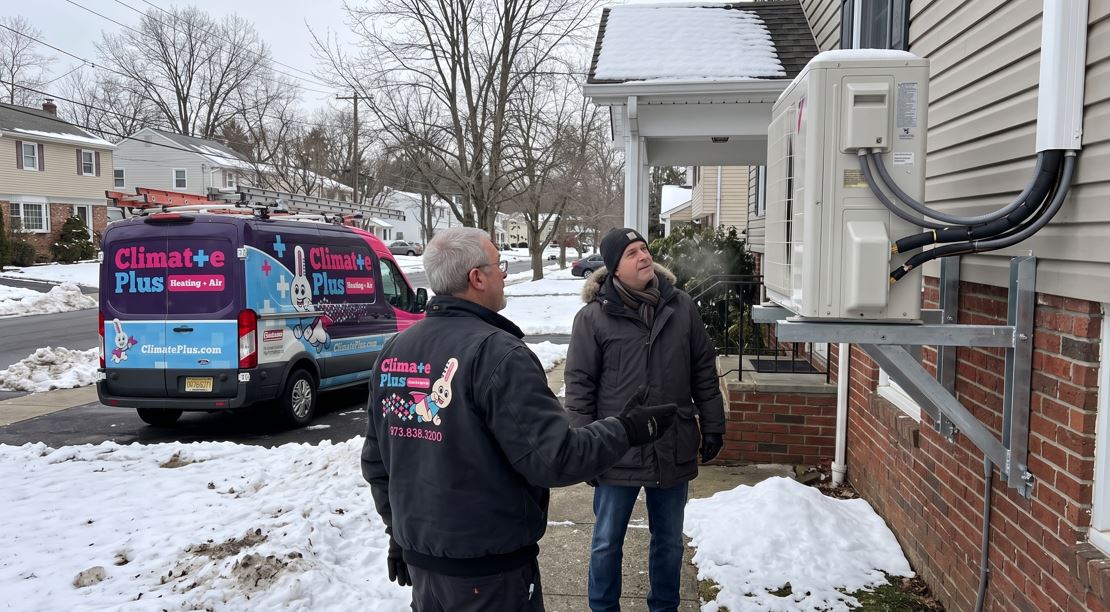
During a sleet or snowstorm, you might suddenly hear a “whoosh” sound from your outdoor unit. The fan might stop spinning, and a cloud of steam might rise out of the top.
Every winter, we get panic calls from new heat pump owners thinking their system is on fire. It’s not! This is the system’s defrost cycle.
When ice builds up on the outdoor coils, the heat pump temporarily reverses itself to melt the ice. It only lasts a few minutes, but it is a perfectly normal, brilliant piece of engineering that keeps your system running through a blizzard.
3. Installation Matters: Snow Stands and Wall Brackets
In North Jersey, we get snow accumulation. If an outdoor heat pump gets buried in a snowdrift, it will suffocate and stop working.
A major difference between a good installation and a bad one is how the outdoor unit is mounted. At Climate Plus, we always elevate your heat pump on specialized snow stands or mount them to the side of the house with heavy-duty brackets to keep them above the local snow line.
Do You Still Need Backup Heat?
While hyper-heating models can handle sub-zero temperatures entirely on their own, many New Jersey homeowners opt for a Dual-Fuel System (sometimes called a hybrid system).
This setup pairs a highly efficient electric heat pump with a traditional gas furnace.
-
When it’s 35°F to 60°F outside: The heat pump does all the work, saving you a massive amount of money on natural gas.
-
When a rare polar vortex hits and it drops to 5°F: The system automatically switches over to your gas furnace to provide that heavy-duty, blasting heat.
This gives you the ultimate peace of mind. You get the incredible efficiency of a heat pump for 80% of the winter, and the reliable horsepower of a gas furnace for the remaining 20%.
Are Heat Pumps a Smart Financial Investment in NJ?
Absolutely. Because they can provide up to three units of heat for every one unit of electricity they consume, they are highly efficient. Plus, they act as world-class air conditioners in the summer, meaning you are upgrading your home’s heating and cooling at the same time.
Even better, the state of New Jersey and the federal government want you to upgrade.
Between federal tax credits under the Inflation Reduction Act and local utility rebates from companies like PSE&G and JCP&L, you can often save thousands of dollars on your installation.
If you want to dive deeper into the financial side of things, check out our dedicated breakdown on is a heat pump worth it in New Jersey’s climate.
Should You Upgrade to a Heat Pump in North Jersey?
Yes, heat pumps absolutely work in New Jersey winters. But the key to a successful heat pump system isn’t just buying a fancy unit. It’s having it properly sized and installed for the specific demands of your home’s ductwork and insulation.
If you’re ready to see if your home is a good candidate, check out our heat pump installation and service page or reach out to the experts at Climate Plus today by calling (973) 838-3200 or contact us online with any additonal quesitons.
We’ll help you design a system that keeps your family warm, your energy bills low, and your peace of mind intact all winter long.